As AI continues to play an influential role in our economy and democracy, AI literacy — the ability to understand, recognize, and use AI responsibly, safely, and effectively — is an increasingly important skill for everyone, and especially for workers. This technology is already producing widespread changes, changes that will be felt most strongly by marginalized people. It is essential that the people who are at the most risk are taught the skills needed to spot AI’s harms and take advantage of its benefits. Ensuring that communities of color about AI must be an essential element of any strategy to advance civil-rights-protective AI.
 Why AI literacy training for workers?
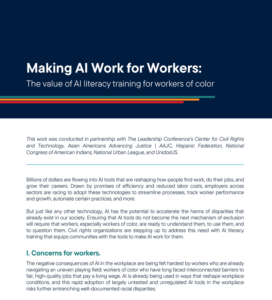
The negative consequences of AI in the workplace are being felt hardest by workers who are already navigating an uneven playing field: workers of color who have long faced interconnected barriers to fair, high-quality jobs that pay a living wage. AI is already being used in ways that reshape workplace conditions, and this rapid adoption of largely untested and unregulated AI tools in the workplace risks further entrenching well-documented racial disparities.
Read Making AI Work for Workers: The value of AI literacy training for workers of color for more.
What should people know about AI?
Duis aute irure dolor in reprehenderit in voluptate velit esse cillum dolore eu fugiat nulla pariatur. Excepteur sint occaecat cupidatat non proident, sunt in culpa qui officia deserunt mollit anim id est laborum.
Read Recommendations for the Public for more.
What should policymakers do?
For AI to deliver real opportunity, all workers need power to shape, scrutinize, and challenge the tools governing their work. However, in the current unregulated environment, AI adoption is widening, not narrowing, the digital divide. Private investment in AI literacy programs naturally flows to already-connected, already-skilled populations, leaving rural, tribal, and low-income communities behind. Only federal incentives can correct this market failure at national scale.
Read Recommendations for Policymakers for more.
How can we make AI literacy trainings that work for our communities?
Lorem ipsum dolor sit amet, consectetur adipiscing elit, sed do eiusmod tempor incididunt ut labore et dolore magna aliqua. Ut enim ad minim veniam, quis nostrud exercitation ullamco laboris nisi ut aliquip ex ea commodo consequat. Duis aute irure dolor in reprehenderit in voluptate velit esse cillum dolore eu fugiat nulla pariatur. Excepteur sint occaecat cupidatat non proident, sunt in culpa qui officia deserunt mollit anim id est laborum.
Read Recommendations for Practitioners for more.
How should businesses use AI responsibly?
Lorem ipsum dolor sit amet, consectetur adipiscing elit, sed do eiusmod tempor incididunt ut labore et dolore magna aliqua. Ut enim ad minim veniam, quis nostrud exercitation ullamco laboris nisi ut aliquip ex ea commodo consequat. Duis aute irure dolor in reprehenderit in voluptate velit esse cillum dolore eu fugiat nulla pariatur. Excepteur sint occaecat cupidatat non proident, sunt in culpa qui officia deserunt mollit anim id est laborum.
Read Implementing AI Responsibly for more.
Resources
- Title title title, Author Organization
- Title title title, Author Organization
- Title title title, Author Organization
- Title title title, Author Organization
 |
The Center for Civil Rights and Technology is a joint project of The Leadership Conference on Civil and Human Rights and The Leadership Conference Education Fund. The Center, launched in September 2023, serves as a hub for advocacy, education, and research at the intersection of civil rights and technology policy. Our experts dive into the most pressing policy issues in three key areas: AI and privacy, voting and platform accountability, and broadband access.
|
 |
Asian Americans Advancing Justice | AAJC advocates for an America in which all Americans can benefit equally from, and contribute to, the American dream. Rooted in the dreams of immigrants and inspired by the promise of opportunity, our mission is to advance the civil and human rights of Asian Americans and to build and promote a fair and equitable society for all. Advancing Justice | AAJC is a national 501 (c)(3) nonprofit founded in 1991 in Washington, D.C. |
 |
Hispanic Federation is the nation’s premier Latino nonprofit membership organization. Founded in 1990, HF empowers Hispanic communities and strengthens Latino institutions through work that focuses on education, health, immigration, civic engagement, economic empowerment, and environmental justice. |
 |
National Congress on American Indians is the oldest, largest, and most representative American Indian and Alaska Native organization serving the broad interests of Tribal governments and communities. Founded in 1944, we engage in legislative and administrative advocacy on behalf of our membership and strive to ensure that member Tribes and individuals are informed and educated about all issues affecting the well-being of Tribal Nations.
|
 |
National Urban League spearheads the efforts of its local affiliates through the development of programs, public policy research, and advocacy. Founded in 1910 and headquartered in New York City, the National Urban League has 92 affiliates serving 300 communities in 37 states and the District of Columbia, providing direct services that impact and improve the lives of more than two million people nationwide.
|
 |
UnidosUS is a nonprofit, nonpartisan organization that serves as the nation’s largest Hispanic civil rights and advocacy organization. Since 1968, they have served the Hispanic community through our research, policy analysis, and state and national advocacy efforts, as well as in our program work in communities nationwide and through our network of over 300 affiliates across the country. |