Why the 2026 Census Test Puts Fair Representation at Risk
An accurate decennial census count is the foundation on which resources, representation, rights are shaped and allocated in this country. But earlier this year, the U.S. Census Bureau made an announcement that could drastically shift the effectiveness of our next census.
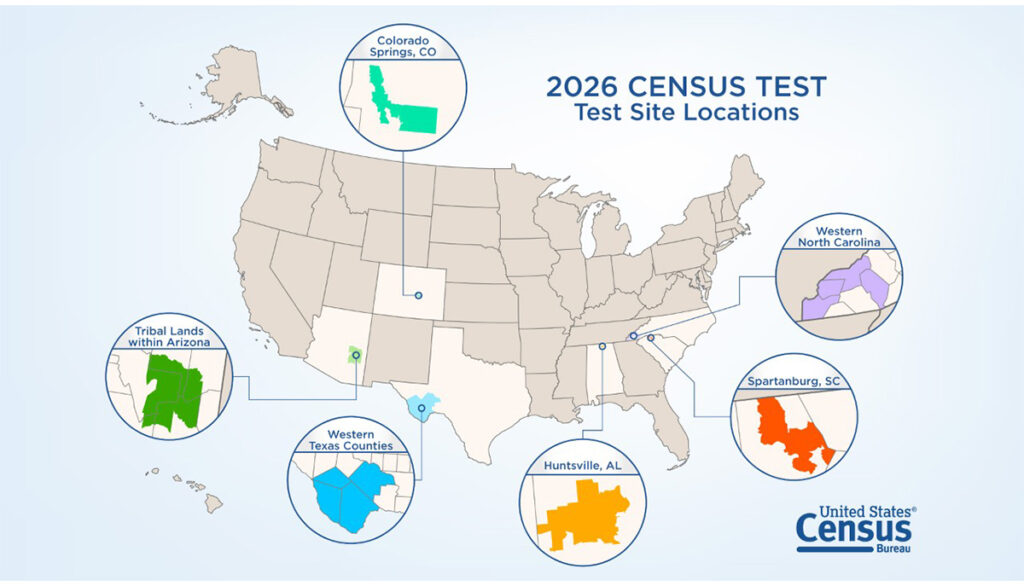
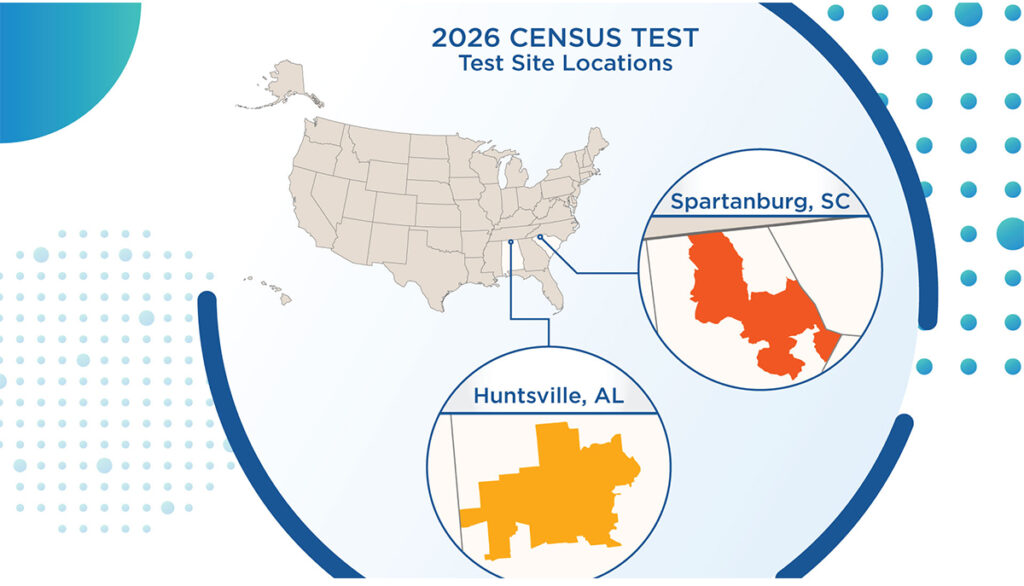
On Feb. 3, 2026, the U.S. Census Bureau published a notice in the Federal Register soliciting comments on the 2026 Census Test, a crucial test in the decennial census cycle that is meant to gauge the ability to reach residents who have typically been the hardest to count. Originally, the Census Bureau proposed six sites for this test: Colorado Springs, CO; Huntsville, AL; Tribal Lands within Arizona; Spartanburg, SC; Western North Carolina; and Western Texas. However, the Census Bureau has since updated the test sites to only include the South Carolina and Alabama sites.
Original Test Sites
Updated Test Sites
This change fundamentally alters the number and types of residents who will be involved in testing; with this, there will not be a representative sample of the country. Additionally, the proposed changes include testing the use of Postal Service workers as enumerators, English-only response options, a modified version of the American Community Survey instead of the decennial form, and only in-field enumeration with no online option. In short, this is no longer a true test for the 2030 Census; now, the only real factor being tested is the viability for postal worker enumeration.
The census advocacy community has spoken in a single, clear voice: these changes are unnecessary and unwanted. Twenty one state attorneys general and the Census Funder Collaborative have highlighted the conclusions from the 2019 of Postal Service in-field enumeration test and the irreconcilable data confidentiality issues:
“‘Following a significant planning effort, it was determined that the pilot could not be implemented because of irreconcilable differences between the requirements of 13 U.S.C. (Census Bureau) and 18/39 U.S.C. (USPS),’… The Federal Register Notice did not indicate that these irreconcilable differences have been addressed, raising questions whether this test can be done.”
Any results yielded from this version of the test will not be applicable to the 2030 Census operations. The 2026 Census Test should be a true reflection of what the 2030 Census will look like. More than 300 comments were submitted telling the Census Bureau just that. The Leadership Conference, along with over 100 signatories, were among the many who submitted a comment to the Census Bureau urging them to restore the earlier version of the test and to fairly count the diverse population of the country.
Meanwhile, the Coalition on Human Needs underscored the importance of a true 2026 Operational Test to improve the count of young children: “We need a greater diversity of test sites in order to understand whether new strategies for counting children will work in a range of environments.”
Several localities, including El Paso County, submitted comments urging the bureau to reconsider on behalf of the Latino population in the Southwest: “Eliminating Western Texas colonias removes critical insight into reaching rural Latinos with limited English proficiency, limited internet access, and those living in ‘hidden housing’ such as converted sheds, garages, or trailers. Eliminating Colorado Springs similarly limits understanding of outreach to hard-to-count Latinos in suburban areas.”
The Prison Policy Initiative also uniquely pointed out the lack of group quarters testing, which has created a repeatedly undercounted population: “People in group quarters account for 3% of the US population; therefore, an accurate 2030 Census requires an accurate count of people in group quarters. The Bureau cannot simply rely on old methods, which have failed it over the past decades… The Bureau’s current plan to focus solely on household units will do nothing to prepare the Bureau for enumerating people in group quarters in 2030.”
Margo Anderson, author of The American Census, alongside 66 Members of Congress, state demographers, state representatives, and passionate individuals also provided comments with similar sentiments.
The 2026 Census Test is an opportunity to update census operations for a new decade and an ever-changing population. However, the changes proposed by the Census Bureau and Department of Commerce won’t modernize the census. These changes will create a census with more inaccuracies and imperfections while wasting taxpayer dollars.
The Census Quality Reinforcement Task Force summed it up clearly in their comment: “By compromising the breadth and depth of pre‐census testing, it undermines the ability of the test to provide valid and essential evidence in support of an accurate and trustworthy decennial population count.”